Description
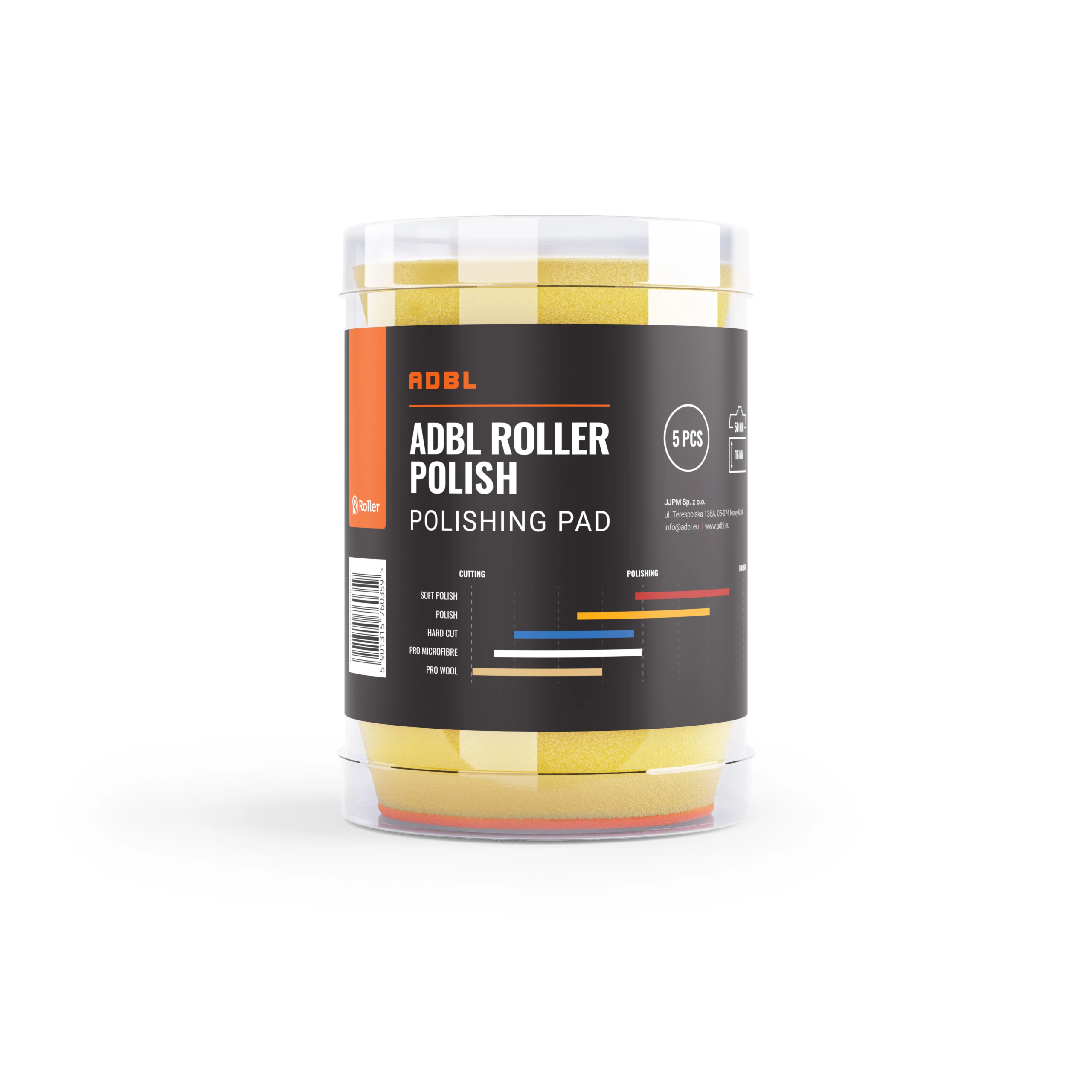
ADBL Roller Polish 50 mm is a compact foam polishing pad designed to balance paint correction and refinement on smaller, curved and difficult-to-reach areas. Its 50 mm working size provides greater coverage than the miniature 30 mm version while retaining the precision needed when conventional polishing pads are too large.
Suitable for compatible Dual Action and rotary polishing machines, Roller Polish sits between the more aggressive Roller Hard Cut and softer Roller Soft Polish pads. This makes it a versatile option for moderate correction, intermediate polishing and situations where you want to improve paint defects without immediately reaching for the most aggressive pad available.
Why choose ADBL Roller Polish 50 mm?
- Balanced correction and refinement – provides a useful middle ground between heavy cutting and fine finishing.
- Compact 50 mm format – combines precision with greater working coverage than the 30 mm version.
- Ideal for smaller and curved areas – useful where conventional 75 mm or 125 mm pads become difficult to position.
- Dual Action and rotary compatible – designed for compatible small-format DA and rotary polishing machines.
- Versatile polishing option – suitable for moderate paint correction and intermediate polishing stages.
- Diamond-shaped profile – helps the pad adapt to curved and intricate surfaces.
- Part of ADBL’s compact Roller system – allows you to move to harder or softer 50 mm pads while maintaining the same working size.
How to use
Thoroughly wash and decontaminate the vehicle before beginning machine polishing.
Inspect the paint under suitable lighting and carry out a test section to determine whether Roller Polish provides the appropriate level of correction.
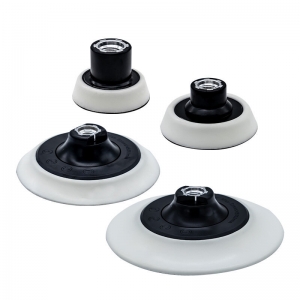
Fit ADBL Roller Polish 50 mm securely and centrally to the appropriate backing plate of your compatible DA or rotary polishing machine.
Apply a small amount of your chosen polishing compound to the pad.
Position the pad correctly against the paint before starting the machine.
Work a small section at a time using controlled movements, appropriate machine speed and moderate pressure. Take particular care around panel edges, body lines and surrounding trim.
Once the polishing cycle is complete, remove the compound residue with a clean microfibre towel and inspect the result.
Clean the pad frequently throughout the polishing process to prevent spent compound and removed paint residue from accumulating in the foam.
If additional correction is required, consider moving to a more aggressive combination. If the defects have been removed but additional refinement is required, follow with a softer pad and suitable finishing polish.
Prestige Detailing Tips
The 50 mm Roller Polish occupies a particularly useful position in a multi-size polishing setup.
The 30 mm version gives you maximum precision for extremely confined areas, while the 75 mm pad is more efficient where additional working space is available. The 50 mm version sits neatly between the two, giving you better coverage than 30 mm without sacrificing the control that makes compact polishing systems useful in the first place.
Within ADBL’s compact foam range, the basic progression is:
Roller Hard Cut → Roller Polish → Roller Soft Polish
That doesn’t mean you need to use all three pads on every job. Carry out a test section first and choose the least aggressive combination capable of producing the required correction.
Compound choice will also substantially change the behaviour of Roller Polish. Pad, compound, machine, paint hardness and technique work together as a system, so don’t judge the required level of correction from the pad name alone.
If Roller Polish isn’t removing the defects efficiently, moving to Roller Hard Cut and an appropriate cutting compound may make more sense than repeatedly polishing the same area.
Likewise, if Roller Polish achieves the required correction but the paint would benefit from additional refinement, switch to Roller Soft Polish or another suitable finishing combination.
Use compound sparingly on compact pads. A 50 mm pad requires far less product than a conventional 125 mm pad, and excessive compound will quickly saturate the foam.
Regular cleaning is equally important. As polishing residue accumulates, the pad’s behaviour and corrective performance can change. Keeping the working face clean helps maintain more consistent results.
Finally, don’t use a 50 mm pad simply because it feels more precise. Larger pads remain much more efficient on broad, relatively flat panels. Save the compact setup for the areas where its additional control actually provides an advantage.
Type: Compact foam polishing pad
Primary use: Paint correction and refinement in smaller areas
Polishing stage: Intermediate / polishing
Machine compatibility: Dual Action (DA) and rotary
Pad size: 50 mm
Profile: Diamond shaped
Prestige Detailing size: 50 mm