You’ve spent the better part of your Sunday morning washing your car. The paintwork looks immaculate, the wheels are gleaming and there’s not a speck of dirt in sight. Job done, right? Not quite. Here’s why your car might not be as clean as you think.
The Rub: Looks Can Be Deceiving
There’s something undeniably satisfying about washing your own car.
Whether it’s the therapeutic appeal of spending a couple of hours outdoors or simply the pleasure of admiring the finished product, a freshly washed car is a sight to behold.
But what if we told you that, despite all your hard work, your car might still be dirty?
Before you reach for your wash mitt again, allow us to explain.
Most car shampoos are designed to remove surface dirt, dust, road grime and other loose contaminants. And provided you’ve followed the correct washing procedures, they’ll do a fine job of it.
The problem is that not all dirt is created equal.
Some contaminants are considerably more stubborn than others. Over time, these can bond to your vehicle’s paintwork, glass and wheels, making them difficult — if not impossible — to remove through conventional washing alone.
Worse still, many of them are practically invisible to the naked eye.
This is where car decontamination comes into the picture.
The Detail: What Your Car Shampoo Leaves Behind
To understand why a freshly washed car isn’t necessarily a completely clean one, we first need to distinguish between two types of contamination: loose and bonded.
Loose contamination includes the everyday dirt and grime that accumulates on your vehicle’s exterior. It’s precisely what your car shampoo, wash mitt and pressure washer are there to remove.
Bonded contamination, on the other hand, is a different kettle of fish.
These are particles and deposits that adhere stubbornly to your vehicle’s surfaces, often resisting even the most thorough wash.
Let’s take a closer look at some of the usual suspects.
1. Iron Fallout: The Invisible Enemy
Every time you apply your brakes, friction between the brake pads and discs generates tiny particles of metallic debris.
Some of these particles settle on your wheels and surrounding bodywork. Others originate from traffic, industrial activity and environmental exposure.
Over time, ferrous particles can become embedded in or firmly attached to your vehicle’s exterior surfaces.
And while you might expect metallic contamination to be immediately noticeable, much of it is surprisingly difficult to spot.
On lighter-coloured vehicles, iron fallout sometimes reveals itself as tiny orange or brown specks. On darker paintwork, however, it can be much harder to identify.
Fortunately, dedicated iron removers such as GYEON Q²M Iron and ADBL Vampire Liquid are formulated to react with ferrous contamination, helping to dissolve and loosen it for removal.
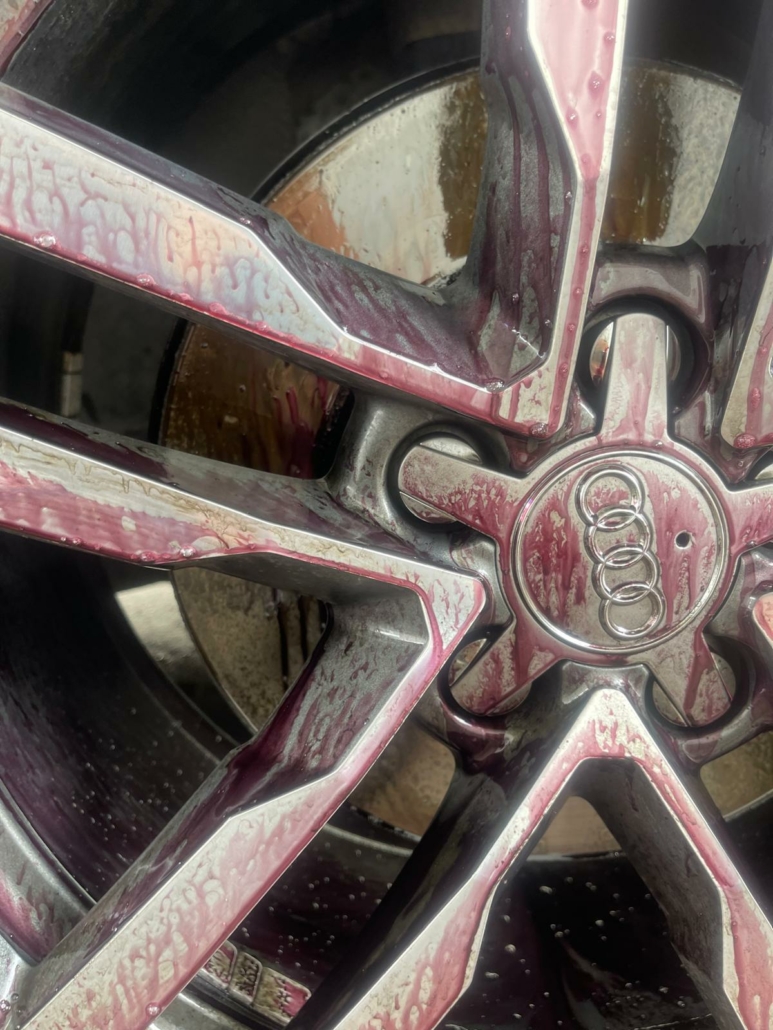
The distinctive purple reaction associated with many iron removers isn’t simply there for dramatic effect. It’s a visible indication of the product reacting with iron contamination.
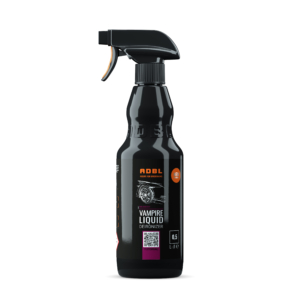
ADBL Vampire Liquid is one of the iron remover options available from our store.
2. Tar Deposits: An Unwelcome Souvenir from the Road
If you’ve ever noticed tiny black spots around your car’s wheel arches, lower doors or rear bumper, there’s a good chance you’ve encountered road tar.
As you drive, small quantities of bituminous material can be thrown up from road surfaces and adhere to your vehicle.
Unlike ordinary dirt, tar is sticky, persistent and particularly resistant to conventional car shampoos.
Trying to remove it through aggressive scrubbing is rarely a good idea, either. The additional friction can introduce scratches and swirl marks into your paintwork.
Instead, a dedicated tar remover, such as ADBL Tar Remover Thixotropic or GYEON Q²M Tar REDEFINED, can soften and dissolve suitable deposits, allowing them to be removed with considerably less mechanical effort.
As with any specialist chemical, it’s important to follow the manufacturer’s instructions and check compatibility with the surface being treated.
3. Mineral Deposits: When Water Leaves Its Mark
It might sound counterintuitive, but the very water you’re using to wash your car can sometimes leave contamination behind.
When water evaporates, dissolved minerals can remain on the surface, creating the familiar circular marks commonly referred to as water spots.
This is particularly relevant in Malta, where hard water can make mineral deposits a recurring headache for car owners.
Not all water spots are alike, however.
Some consist of relatively superficial mineral residue that can be removed using an appropriate water-spot remover. Others may have contributed to etching or damage that requires more involved corrective work.
The distinction matters because no amount of ordinary shampooing will reverse genuine surface etching.
Prevention, as ever, is preferable to cure. Washing your car out of direct sunlight and drying it promptly with a suitable microfibre drying towel can significantly reduce the likelihood of water spots forming.
4. Environmental Contamination: Malta’s Contribution
Living in Malta presents its own set of challenges when it comes to keeping a vehicle clean.
Between airborne dust, construction activity, coastal exposure and the occasional Saharan dust event, our cars are rarely afforded much respite.
Add tree sap, bird droppings and other environmental deposits to the equation, and it’s easy to see why maintaining a spotless exterior can become a never-ending exercise.
Not all these contaminants behave in the same way, of course.
Bird droppings, for instance, can damage paintwork if left unattended, while tree sap may require a dedicated cleaning solution.
The important takeaway is that different forms of contamination demand different approaches.
And that’s precisely why reaching for a stronger shampoo isn’t always the answer.
The Detail: How Can You Tell If Your Car Is Contaminated?
Now that we’ve established what might be lurking on your paintwork, the next question is fairly obvious: how do you know whether your car needs decontaminating?
Fortunately, there are a few telltale signs.
The first is visual. Look closely at your wheels, lower body panels and horizontal surfaces for small orange specks, black deposits or persistent water spots.
The second involves touch.
After thoroughly washing and drying your vehicle, carefully assess whether the paintwork feels smooth or unusually rough.
Experienced detailers sometimes use a thin plastic bag over their fingers to amplify the sensation of bonded contamination. However, this should only be attempted on a completely clean surface, using extremely light pressure, to avoid introducing scratches.
If the surface feels gritty despite having been washed, there’s a reasonable chance bonded contaminants are present.
It’s worth remembering, though, that roughness alone doesn’t tell you which contaminants you’re dealing with.
And that brings us to the next step.
The Detail: Chemical vs Mechanical Decontamination
In the detailing world, decontamination generally falls into two categories: chemical and mechanical.
Chemical decontamination involves using specialist products designed to target particular types of contamination.
Iron removers tackle ferrous particles, tar removers address bituminous deposits, and dedicated mineral removers can help eliminate certain water spots.
The advantage is straightforward: these products can loosen or dissolve contaminants without relying on excessive rubbing.
Mechanical decontamination, meanwhile, involves physically removing bonded particles using tools such as clay bars and clay mitts.
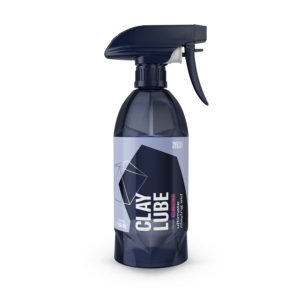
Clay lubricants like GYEON Q²M ClayLube REDEFINED are another essential mechanical decontamination tool for your detailing arsenal.
When performed correctly, claying can leave paintwork noticeably smoother and better prepared for subsequent detailing procedures.
There’s a catch, however.
Mechanical decontamination introduces friction, and friction brings with it the possibility of marring or scratching your paintwork.
For this reason, we generally favour appropriate chemical decontamination before considering whether mechanical intervention is necessary.
And even then, claying shouldn’t automatically become part of every maintenance wash.
The objective isn’t to subject your paintwork to as many treatments as possible. It’s to use the least aggressive effective method to achieve the desired result.
The Finish: A Clean Car Is More Than Meets the Eye
If there’s one thing we’d like you to take away from this article, it’s that washing and decontaminating your car are two different processes serving two different purposes.
Regular washing removes everyday dirt and grime, helping maintain your vehicle’s appearance and reducing the accumulation of harmful deposits.
Decontamination goes a step further, addressing the stubborn particles and residues that conventional washing can leave behind.
Does that mean you need to decontaminate your vehicle every time you wash it?
Absolutely not.
How frequently your car requires decontamination depends on several factors, including driving conditions, where it’s parked, the condition of its protective coating and the types of contamination it’s exposed to.
At Prestige Detailing, decontamination is also an important part of preparing vehicles for procedures such as paint correction and ceramic coating application.
After all, there’s little sense in polishing or protecting a surface that hasn’t been properly prepared.
For those interested in learning more about the process, we’ve explored it in greater detail in our Ceramic Coating 101 series, including our guides to safe washing and vehicle decontamination.
And if you’re unsure which products or techniques are appropriate for your own vehicle, feel free to get in touch with our team.
Sometimes, achieving a genuinely clean car isn’t about washing it harder.
It’s about understanding what you’re trying to remove in the first place.