Description
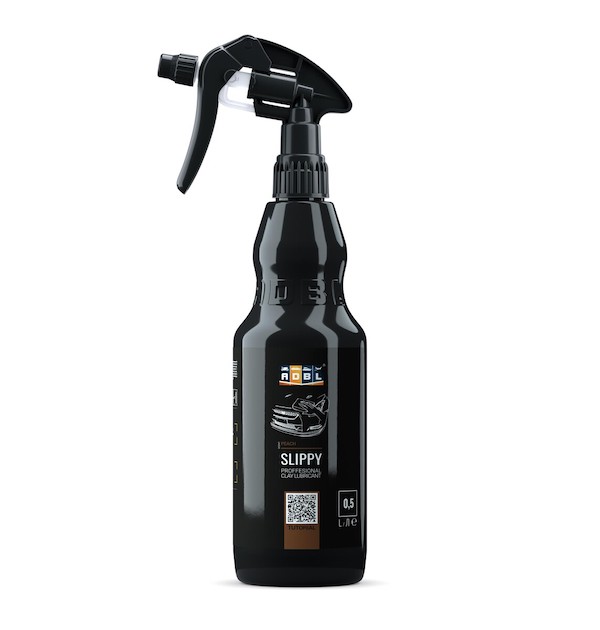
ADBL Slippy is a dedicated clay lubricant designed to reduce friction between your vehicle’s paintwork and a clay bar or synthetic clay product during mechanical decontamination. By creating a slick working surface, it allows your chosen clay media to glide more freely across the paint while you remove stubborn bonded contamination.
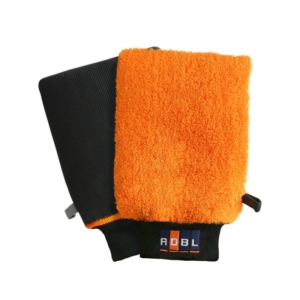
Designed to combine effective lubrication with a quick and convenient working process, ADBL Slippy doesn’t necessarily need to be rinsed away after claying. Once you’ve finished working a section, the remaining product can simply be wiped away. It also pairs particularly well with products such as ADBL ClayMitt.
Why choose ADBL Slippy?
- Dedicated clay lubricant – specifically formulated to provide lubrication during mechanical paint decontamination.
- Reduces friction – creates a slick interface between automotive paintwork and clay or polymer decontamination media.
- Helps improve claying safety – sufficient lubrication allows your clay media to move across the surface without unnecessary grabbing.
- Works with traditional and synthetic clay media – suitable for clay bars as well as compatible polymer decontamination products.
- Ideal partner for ADBL ClayMitt and Clay Sponge – both products are specifically recommended by ADBL for use with Slippy.
- No mandatory rinse after claying – remaining product can simply be wiped away once you’ve completed the section.
- Can double as a drying aid – ADBL specifies a 1:2 dilution for this secondary application.
How to use
Thoroughly wash and rinse the vehicle before beginning mechanical decontamination. Never clay dirty paintwork.
Where necessary, carry out chemical decontamination first to remove contamination such as iron particles and tar. Thoroughly rinse these chemicals from the vehicle before proceeding to the claying stage.
Working one panel or manageable section at a time, spray a generous amount of ADBL Slippy onto the surface.
Pass your clay bar, clay mitt or clay sponge gently across the lubricated paintwork using controlled movements and minimal pressure.
Maintain sufficient lubrication throughout the process. If the clay begins to grab rather than glide smoothly, stop and apply additional Slippy rather than increasing pressure.
Regularly inspect and, where appropriate, clean your chosen clay media to minimise the risk of dragging accumulated contamination across the paint.
Continue working until the bonded contamination has been removed and the surface feels smooth.
Once you’ve finished the section, wipe away the remaining ADBL Slippy with a clean microfibre towel. ADBL states that the product does not need to be washed away after use.
Proceed around the vehicle one section at a time.
ADBL Slippy can also be diluted 1:2 with water and used as a drying aid.
Prestige Detailing Tips
Don’t be stingy with clay lubricant. Mechanical decontamination works by physically passing clay or a synthetic polymer surface across your paintwork. Adequate lubrication is therefore an important part of reducing unnecessary friction during the process.
If your clay media starts grabbing, don’t compensate by pressing harder. Stop, apply more ADBL Slippy and continue with light, controlled passes.
We’d also recommend carrying out the appropriate chemical-decontamination stages before reaching for your clay product when the vehicle is heavily contaminated. Removing iron particles and tar chemically first means your clay has less contamination to tackle mechanically.
For example, ADBL Vampire Liquid can be used to tackle ferrous contamination, while ADBL Tar Remover Thixotropic is designed for tar and bituminous deposits. Thoroughly remove these chemicals before beginning the mechanical-decontamination stage.
This is particularly important when using synthetic clay products such as ADBL ClayMitt. ADBL specifically warns against combining its polymer clay products directly with solvent-based products such as tar removers.
Slippy and ADBL ClayMitt make a particularly convenient combination. Spray enough Slippy onto the panel to create a slick working surface, then move the ClayMitt gently across the paint using straight horizontal and vertical passes. There’s no need to aggressively scrub the surface.
Traditional clay bars also require proper lubrication. ADBL specifically instructs users of its own Clay Bar range to use a suitable clay lubricant such as Slippy.
Remember that claying is a mechanical process. Depending on the paint system, contamination level, clay media and technique, some degree of marring is possible. If you’re preparing a vehicle for machine polishing, this can form part of the overall correction process. If you don’t intend to polish afterwards, work particularly conservatively.
Finally, don’t overlook Slippy’s secondary use. ADBL states that it can be diluted 1:2 with water and used as a drying aid, giving the product some additional versatility beyond its primary role as a clay lubricant.
Type: Clay lubricant
Primary use: Mechanical paint decontamination
Compatible media: Clay bars and compatible polymer clay products
Recommended ADBL accessories: ADBL ClayMitt
Rinsing required after claying: No
Secondary use: Drying aid
Drying-aid dilution: 1:2 with water
Scent: Peach
Prestige Detailing sizes: 200 ml, 500 ml, 1 L and 5 L
Catalogue references:
200 ml – ADB000369
500 ml – ADB000346
1 L – ADB000347
5 L – ADB000348