We’re asked this question a lot at our studio here at Prestige Detailing, so by addressing it here we thought we’d save you some bother looking elsewhere online.
Car wax vs polish: Which should you use?
You’ve just finished washing your car. The paintwork is clean, the wheels are spotless and everything looks reasonably good. But something’s missing. Perhaps the paint doesn’t have quite the gloss it once did, or maybe those annoying little scratches are still visible whenever the sun hits the bodywork.
So, what’s the solution? A good car wax? A polishing compound? Both?
Although the terms are sometimes used interchangeably, car wax and car polish serve two very different purposes. Understanding the distinction can save you time, money and, potentially, a lot of unnecessary work.
Let’s get into it.
The Rub: What’s the difference between car wax and polish?
The simplest way to explain the difference is this: car polish corrects paintwork, while car wax protects it.
A car polish uses fine abrasives to remove a very thin layer of material from the paint’s surface, reducing imperfections such as light scratches, swirl marks, oxidation and haziness. By levelling the surface, polishing can restore clarity and gloss.
Car wax, meanwhile, forms a protective layer over the paintwork. Depending on its formulation, it can enhance gloss, improve water repellency and offer some protection against environmental contamination.
Here’s the important part: wax doesn’t remove scratches, and polish isn’t a substitute for paint protection.
You might occasionally find products marketed as cleaner waxes or all-in-one polishes that combine several functions. But for the purposes of this guide, we’re talking about dedicated polishing and protection products.
The Detail: What does car polish actually do?
Think about the way sunlight reflects off a freshly detailed car. When the paint is in good condition, the reflections appear crisp and clear.
Over time, however, everyday washing, improper drying and general wear can introduce thousands of tiny imperfections into the clear coat. These scatter light, making the paint appear dull or covered in fine circular scratches.
That’s where polishing comes in.
Most modern cars have a multi-layer paint system, with a transparent clear coat protecting the colour beneath. Abrasive polishing removes a controlled amount of material from the upper surface of that clear coat, reducing the appearance of shallow defects.
The result? Smoother paintwork, sharper reflections and improved gloss.
Not all polishes are created equal
Polishing products vary in their cutting ability.
Heavy-cut compounds are designed to tackle more pronounced defects, such as deeper swirls, sanding marks and significant paint imperfections. They generally require more care and may need to be followed by a finishing polish.
Medium-cut polishes offer a balance between correction and refinement, making them useful for moderate paint defects.
Finishing polishes use finer abrasives to improve clarity, remove light hazing and refine the finish after more aggressive correction.
Products such as GYEON Q²M Polish are suitable for lighter correction and finishing work, while stronger compounds are available for more demanding jobs.
The choice of polishing pad, machine, technique and paint hardness also influences the result. A finishing polish paired with an aggressive pad, for example, may behave differently from the same polish used with a soft finishing pad.
Can polishing remove every scratch?
Unfortunately, no.
Light swirl marks and superficial scratches can often be reduced or removed through careful polishing. Deeper scratches, particularly those extending beyond the clear coat, may require professional refinishing.
And there’s a reason to be cautious: every abrasive polishing session removes some paint material.
That’s why we recommend starting with the least aggressive combination capable of achieving the desired result. A small test spot is an excellent way to establish what your paintwork needs before committing to the entire vehicle.
Professional detailers may use paint thickness gauges to assess coating thickness and identify potentially vulnerable areas. However, conventional gauges generally measure the combined coating layers rather than the clear coat alone, so they cannot establish an exact safe polishing allowance.
If you’re unsure about the condition of your paintwork, seeking professional advice is always preferable to experimenting with increasingly aggressive compounds.
The Detail: What does car wax do?
If polishing is about correcting the paint, waxing is about preserving its appearance.
Car wax creates a sacrificial protective layer over the paintwork. Depending on the product, this can improve water beading, make routine cleaning easier and provide a degree of protection against environmental exposure.
Many waxes also enhance the paint’s appearance, adding warmth, depth or gloss.
But here’s something worth remembering: wax doesn’t repair damaged paint.
Some formulations contain ingredients that temporarily mask extremely fine imperfections, but they don’t permanently remove scratches or restore damaged clear coat.
A waxed car can look fantastic, even without polishing. If the paintwork is already in good condition, there may be absolutely no reason to reach for a polishing machine.
What about ceramic coatings?
Ceramic coatings are another form of paint protection, but they differ from traditional waxes in their chemistry, application requirements and expected durability.
Products such as GYEON Q² Pure EVO are designed to provide longer-lasting protection than many conventional waxes, although actual performance depends on preparation, application, maintenance and environmental conditions.
Importantly, a ceramic coating isn’t a substitute for paint correction either.
If the paint has visible swirls or defects, applying a coating generally won’t remove them. In fact, the coating may preserve the appearance of those imperfections beneath it.
That’s why proper surface preparation is so important before applying long-term protection.
The Detail: Should you polish your car before waxing it?
Not necessarily.
One of the biggest misconceptions in car care is that every waxing session needs to be preceded by polishing.
It doesn’t.
If your paintwork is clean, smooth and free from defects that bother you, there’s little reason to remove clear coat simply to apply wax.
A thorough wash, appropriate decontamination where necessary, and suitable surface preparation may be all that’s required.
On the other hand, if your car has visible swirl marks, light scratches or dull paint caused by surface defects, polishing before waxing can make a significant difference.
The usual sequence looks something like this:
- Wash: Safely remove loose dirt and road grime using an appropriate car shampoo and wash media.
- Decontaminate: Remove bonded contamination, such as iron deposits and tar, using suitable chemical products and mechanical decontamination where necessary.
- Assess the paint: Inspect the surface under good lighting to determine whether polishing is required.
- Polish if needed: Choose an appropriate combination of polish and pad, starting with a test spot and the least aggressive effective method.
- Prepare the surface: Remove polishing oils or residue where required by the protection product’s instructions.
- Protect: Apply your chosen wax, sealant or ceramic coating according to the manufacturer’s directions.
It’s worth noting that mechanical decontamination can itself introduce light marring, particularly on softer paint. It should be performed only when needed and with an appropriate lubricant.
The Detail: Can you polish your car by hand?
Yes, although there are limitations.
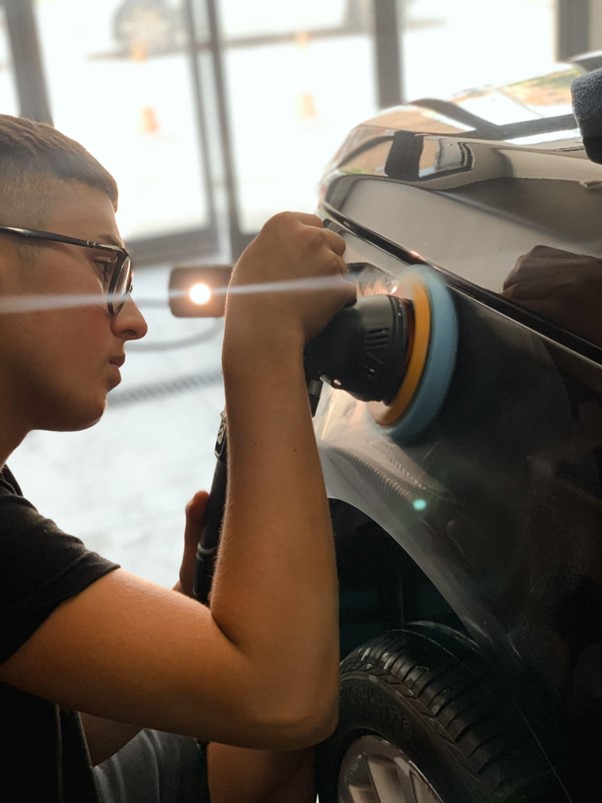
Hand polishing can be useful for small areas, minor blemishes and light correction. It can also be a practical option for enthusiasts who don’t own a machine polisher.
However, achieving consistent correction across an entire vehicle by hand is difficult and time-consuming.
A suitable dual-action machine polisher generally offers a more efficient and consistent approach to paint correction, particularly for larger panels and widespread swirl marks.
Rotary polishers can also deliver excellent results in experienced hands, but they require careful control because of the potential for concentrated heat and aggressive material removal.
If you’re new to machine polishing, a dual-action polisher is generally the more approachable starting point.
And remember: not every mark needs to be removed. Sometimes preserving the paint is more important than chasing perfection.
The Finish: Wax, polish or both?
So, which should you choose?
The answer depends on the condition of your paintwork and what you’re hoping to achieve.
If your car is already looking good and you simply want to maintain its appearance, a quality wax or other suitable protection product may be all you need.
If the paint has lost clarity because of swirl marks, light scratches or oxidation, careful polishing can help restore its appearance. You can then apply wax or another protection product to help maintain the finish.
If the paint feels rough despite washing, investigate bonded contamination before reaching for a polish.
And if you’re dealing with deep scratches, failing clear coat or other significant paint damage, professional assessment is the sensible route.
Ultimately, polishing should be carried out when the paint needs correction, not simply because it’s time to wax the car.
At Prestige Detailing, we work with paint correction and protection products every day, and one principle guides our approach: achieve the best possible result while preserving as much of the original paintwork as possible.
Whether you’re looking for a finishing polish, a more aggressive cutting compound or a quality paint protection product, you’ll find a selection of professional car care solutions in our online store.
Explore our Polishes & Compounds range, or get in touch at [email protected] if you’re unsure which approach is right for your vehicle.